Healthcare Software Integration Challenges

Hospitals operate multiple specialized systems, but seamless integration remains a major barrier to digital healthcare transformation.

The Reality of Modern Hospital IT Environments

Healthcare institutions rely on HMS, LIS, RIS, PACS, billing systems, and medical devices from different vendors, leading to fragmented workflows. Without proper integration, manual data transfer increases delays, workload, and data inconsistency.

As hospitals expand services and adopt new technologies, integration challenges become more complex and costly. Addressing these issues requires a structured, scalable integration approach rather than isolated system upgrades.
Common Integration Challenges Hospitals Face

Hospitals may often use multiple systems that were never designed to communicate with each other, resulting in isolated data silos.

Patient information must be manually duplicated across departments, increasing administrative effort and the risk of errors.

Inconsistent patient identifiers across clinical, diagnostic, and billing systems cause reconciliation issues.

Lab and radiology results are often delayed in reaching the central HMS, affecting clinical decision-making.

Integrating medical devices frequently requires custom interfaces and specialized protocol handling.

Legacy healthcare applications lack modern APIs, making integration complex and costly.

Operational Impact of Poor Integration

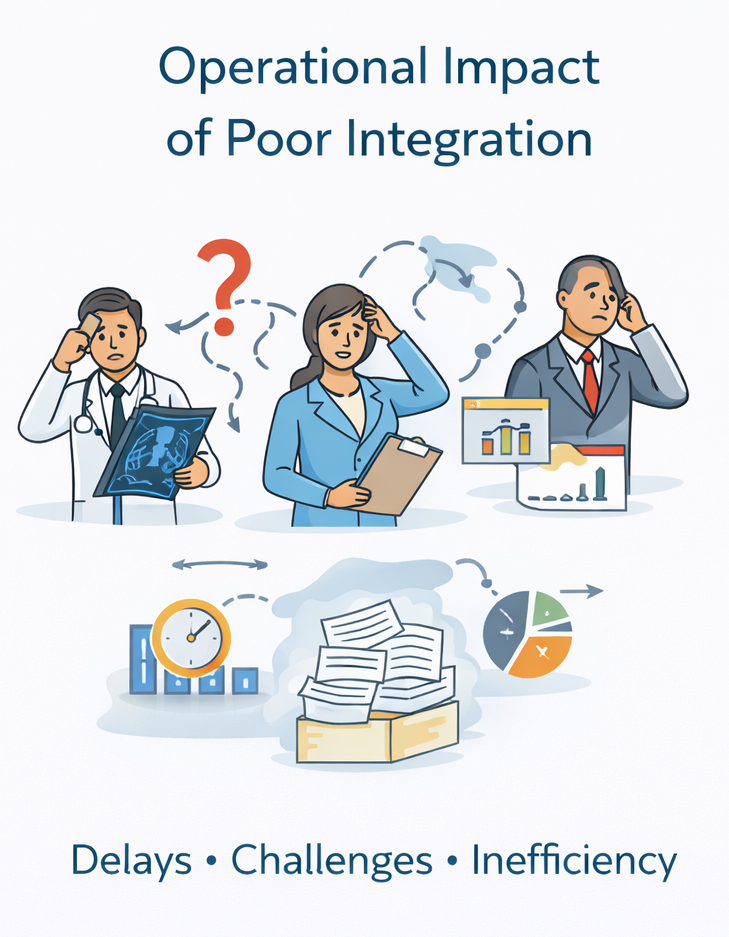
Poor integration affects clinicians, administrators, and management. Diagnostic delays, reconciliation challenges, and lack of unified reporting reduce operational efficiency. Operational inefficiencies increase workload, reduce productivity, and impact overall quality of care. Over time,lack of integration limits visibility, reporting accuracy, and informed decision-making.

Disconnected systems slow down clinical workflows and delay access to critical patient information. Staff spend valuable time switching between applications instead of focusing on patient care.

operational imapct of poor integration

Our Approach to Healthcare System Integration

Our approach focuses on building a structured integration layer that connects existing hospital systems without disrupting daily operations. We design structured integration layers that connect existing system without forcing disruptive replacements.

By using standardized interfaces and secure APIs, we ensure reliability, scalability, and long-term maintainability. This approach allows hospitals to modernize incrementally while preserving existing system investments.

Integration Strategies We Implement

We develop robust interfaces between HMS, LIS, RIS, PACS, pharmacy, and billing systems.

Secure API layers are enabled for legacy healthcare applications without disrupting operations.

Automated data synchronization eliminates manual duplication.

Integration workflows align with real clinical processes.

High-volume diagnostic environments are optimized for performance and reliability.

Modernization Without Replacing Everything

Modernization does not always require replacing existing hospital systems. By introducing interoperability layers and modular enhancements, hospitals can improve workflows while keeping core platforms intact. Incremental upgrades make it easier to validate changes, manage risk, and train users gradually.

This approach reduces risk, controls cost, and avoids disruption to critical clinical and operational processes. Over time, systems evolve smoothly without affecting service continuity or compliance requirements.

Who Needs This Type of Consulting?

  • Hospitals expanding diagnostic or specialty services
  • Healthcare groups merging multiple facilities
  • Organizations struggling with disconnected billing or reporting
  • Providers planning phased digital transformation
  • Institutions requiring reliable on-premise integration