OVID HMS vs Offline HMS
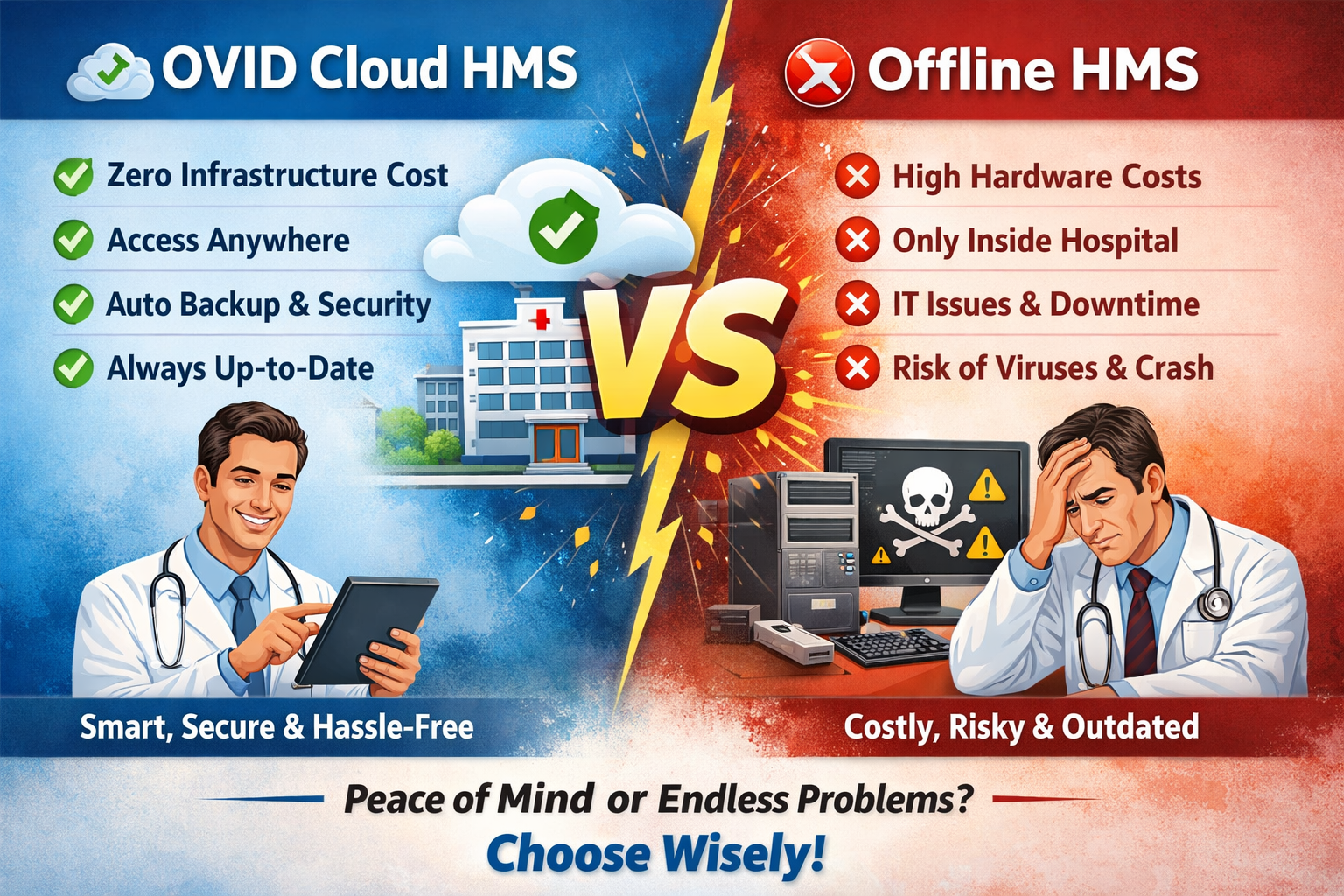
A clear comparison between modern cloud-based OVID HMS and traditional offline systems.
Understand the real cost difference and why modern hospitals are shifting to cloud-based systems like OVID HMS.
A clear comparison between modern cloud-based OVID HMS and traditional offline systems.
| Cost Component | Offline HMS | Cloud HMS (OVID) |
|---|---|---|
| Initial Setup | ₹50000 | ₹25000 - ₹1 Lakh |
| Hardware | ₹3 – ₹15 Lakhs | ₹0 |
| Software License | ₹25000 | Included |
| IT Staff | ₹3 – ₹10 Lakhs/year | Not Required |
| Maintenance | ₹1 – ₹5 Lakhs/year | Included |
| Updates | Paid | Free |
| Backup | Extra Cost | Included |
| 5-Year Cost | ₹10 – ₹20 Lakhs | ₹1.25 - 5lakhs |
On-premise systems require continuous maintenance, upgrades, and manpower costs, which significantly increase total cost over time.
Cloud eliminates hardware and maintenance burden while significantly reducing upfront investment.
| Timeline | Offline HMS | Cloud HMS |
|---|---|---|
| Year 1 | Very Expensive | Very Affordable |
| Year 3 | Still High | Stable |
| Year 5 | Comparable | Comparable / Lower |
| Year 10 | Cheaper (Outdated) | Modern & Scalable |
Offline HMS appears cheaper only after many years, but technology becomes outdated and requires reinvestment, restarting the cost cycle.
Cloud enables anywhere access, scalability, and reliability — something offline systems cannot match.
Hospitals and doctors should focus on what truly matters — delivering quality healthcare and managing clinical operations. Running and maintaining IT systems is a specialized discipline that requires dedicated expertise, infrastructure, and continuous monitoring.
Healthcare providers are not IT service companies. Managing servers, handling software issues, troubleshooting downtime, and maintaining backups should not distract clinical teams from patient care. These responsibilities are best handled by professional IT providers.
With a cloud-based system like OVID HMS, all IT complexities — servers, updates, security, uptime, and backups — are managed by experts. This ensures hospitals can operate smoothly without worrying about technical disruptions.
Imagine a patient waiting at the billing counter and being told, "Our server is down" or "We are fixing a software issue." Such situations not only delay service but also impact trust and professionalism. Modern hospitals cannot afford these disruptions.
Let IT experts handle the technology, while hospitals focus on saving lives and delivering care. That is the real advantage of moving to a reliable cloud HMS.
One critical question hospitals must ask is — how do you continuously add new features and keep an offline system secure? Every enhancement requires manual upgrades, downtime, vendor dependency, and additional cost. Unlike cloud systems, offline HMS does not evolve automatically, leaving hospitals stuck on outdated technology.
Cybersecurity risks today are very real and rapidly increasing. Hospitals running on Windows-based local systems are especially vulnerable to crashes, malware, and virus attacks. Maintaining security requires constant patching, antivirus management, firewall configuration, and monitoring — all of which demand time, expertise, and ongoing expense.
In contrast, OVID HMS runs on secure Linux-based cloud infrastructure, designed for stability, security, and continuous monitoring. Security updates, patches, and threat protection are handled proactively by experts, eliminating the burden on hospital staff.
Healthcare organizations globally are increasingly targeted by ransomware because of the sensitive nature of their data and the urgency of their operations. These attacks can completely halt hospital workflows, delay treatments, and compromise patient safety.
Protecting against such threats is not a one-time effort — it requires continuous monitoring, updates, and specialized expertise. This is why relying on in-house or outdated systems can be risky and costly in the long run.
OVID HMS has been continuously evolving since 2018. We actively listen to our customers, understand real-world hospital challenges, and consistently add new features — at no extra cost. Our goal is not just to provide software, but to build a long-term technology foundation for your hospital.
A Hospital Management System is not a fancy outfit meant to impress others or showcase externally. It is a critical backbone of your hospital operations — something that must work reliably every single day, without fail.
Choosing the right HMS is not about how it looks — it is about how it performs over years of usage. A strong, stable, and evolving system ensures your hospital runs smoothly without interruptions, technical stress, or hidden costs.
“Offline HMS looks cheap today, but cloud HMS is cheaper, safer, and more powerful in the long run.”
You are not just buying software — you are investing in future-proof hospital management. Offline systems lock you into outdated technology, while OVID HMS grows with your hospital.
Cybersecurity threats in healthcare are not theoretical — they are happening globally, affecting hospitals, patient care, and critical operations. The healthcare sector has become one of the most targeted industries for ransomware attacks due to the sensitivity of patient data and the urgency of hospital services.
The ransomware attack on AIIMS Delhi forced the hospital to switch to manual operations for several days, disrupting appointments, billing, and patient care systems . Such incidents clearly show how vulnerable traditional systems can be.
These incidents highlight a critical reality — cyberattacks can completely disrupt hospital operations, delay treatments, and compromise sensitive patient data. Investing in secure, professionally managed systems is no longer optional — it is essential for modern healthcare.
Experience a modern, secure, and hassle-free hospital management system.